
For years analysts liked to call Brazil a “sleeping giant” of online gambling. The country had more than 210 million people, an obsession with football and a betting habit that mostly flowed to offshore sites paying nothing at home. That description no longer fits. On 1 January 2025 Brazil opened a fully licensed online betting market, and inside a single year it grew into the largest in Latin America and one of the biggest anywhere.
We have followed that turnaround from the start. When we first covered Brazil in our 1H2022 report, the market was still stuck in limbo: a betting bill had cleared the lower house of Congress but kept stalling, nearly all the action ran through offshore sites, and the open question was simply when, or even whether, a real framework would arrive. This update returns to the same market with the answer finally in hand, and the first year of hard numbers to show for it.

Brazilian Gambling Market: General Overview
The interest and propensity of the population to the gambling industry have been growing immensely for the past several years. For a long time, the only thing missing was a clear law. That gap closed at the end of 2023, when President Lula signed Law No. 14,790, the legislation Brazilians now call the “Lei das Apostas”, setting federal rules for online fixed-odds sports betting and online casino play.
The country’s history with gambling has never been simple. Casinos were legal and glamorous after President Getúlio Vargas allowed them in 1934, and venues such as Rio’s Cassino da Urca drew stars like Carmen Miranda. President Dutra shut them down in 1946 with Decree-Law No. 9,215, the same decree that still keeps physical casinos illegal today. For decades after that, legal betting meant the state lotteries, the racetrack and the unofficial “jogo do bicho”. Fixed-odds sports betting was opened up in principle by Law No. 13,756 in 2018, but it took the 2023 law to turn that into a working market.
Day-to-day oversight belongs to the Secretariat of Prizes and Bets (Secretaria de Prêmios e Apostas, or SPA), a department inside the Ministry of Finance that the 2023 law created. The bar to enter is high. An operator has to set up a Brazilian company with at least 20% local ownership, pay a licence fee of R$30 million for five years that covers up to three brands, and run only on an approved “.bet.br” address. Customers sign up with their CPF tax number and a facial-recognition check, credit cards are off the table, and money moves through Pix, the central bank’s instant-payment system.
The picture today is very different. Online sports betting, online casino games and fantasy sports are all regulated and licensed, while the state lotteries, horse racing and skill games such as poker stay legal as before. The line in the sand is land-based gambling: physical casinos, gaming machines and commercial bingo are still banned under the 1946 decree. A separate bill, PL 2,234/2022 (the old PL 442/91), would legalise resort casinos, bingo and the jogo do bicho, but it has been sitting in the Senate without a final vote.
Brazil presents countless opportunities for gaming operators to expand their operations as it is one of Latin America’s biggest consumer bases with the population of over 212 million people, (the 6th largest country globally) longing for legal gambling venues.
The first year of real trading settled the argument. Licensed operators booked around R$37 billion (close to US$7 billion) in gross gaming revenue in 2025, ahead of the R$31 billion the government had pencilled in. More than 80 operators held federal licences by early 2026, the Federal Revenue Service took in close to R$10 billion in tax, and licence fees added roughly R$2.5 billion on top. The numbers below give the shape of that first year.
Brazil’s Regulated Betting Market in Its First Year (2025)
| Indicator | Figure |
|---|---|
| Gross gaming revenue (GGR) | R$37 billion (~US$7 billion) |
| People who placed a bet | 25.2 million (11.8% of the population) |
| Licensed operators | 80+ (around 138 brands) by early 2026 |
| Tax collected in 2025 | R$10 billion |
| Licence fee | R$30 million per operator, five years, up to 3 brands |
| Self-exclusion requests (first 40 days) | 217,000+ |
| Forecast GGR by 2030 | R$64 billion |
Sources: Secretariat of Prizes and Bets (SPA), Federal Revenue Service, H2 Gambling Capital.
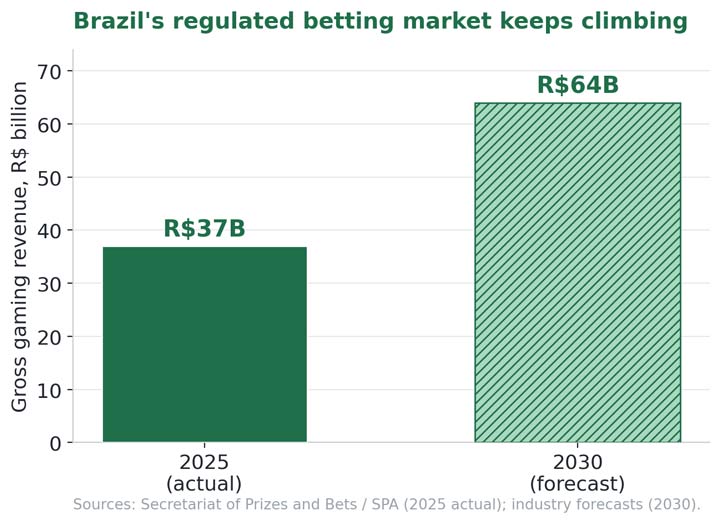
Those early forecasts now look timid. Most analysts expect the market to keep climbing quickly, with projections pointing to roughly R$64 billion in GGR by 2030. That would confirm Brazil as the third-largest online gambling market on the planet, behind only the United States and the United Kingdom.
The illegal market has not gone away. Through 2025 the SPA blocked more than 25,000 unlicensed sites, closed hundreds of bank accounts and forced betting ads off the feeds of non-compliant influencers. Surveys still show many Brazilians cannot tell a licensed site from an offshore one, so moving players onto the regulated “.bet.br” brands is the regulator’s main job for the next few years.
Brazilian Gambler’s Profile
With a full year of regulated data, the guesswork is gone. About 25.2 million Brazilians placed at least one bet on a licensed platform during 2025, roughly 11.8% of the population. The typical player is young and male: men make up 68.3% and women 31.7%, and the busiest age group is 31 to 40 (28.6% of bettors), with the 18-to-24 and 25-to-30 brackets just behind on 22.7% each. People over 60 account for only 2.7%.
Another interesting fact about the Brazilian gamblers is the vast majority of respondents (67%) perceive gambling as entertainment. 43% and 38% of the respondents see betting as a business and sport, respectively. And about a third of the study participants indicated gambling as an opportunity and one of the top motivators to make new friends or socialize with their current friends.
Spending turned out to be the most sensitive number of all. Most players stake small amounts, but a heavy-spending minority drives much of the revenue, and the regulator’s figures show older bettors deposit far more than younger ones. That imbalance is why player protection moved to the top of the agenda. Deposit limits, clear ‘18+’ warnings and a national self-exclusion register, which went live in December 2025, are now core parts of the system. The register took more than 217,000 requests in its first 40 days.
Among the favourite types of bets turned out to be single bets as indicated by 55% of the respondents, multiples are preferred by 42% of the gamblers and doubles are loved by 36% of the bettors.
The most important factors to choose this or that site, as stated by the respondents, are the payout speed, good bonuses, availability of various payment methods, the best odds, and large libraries of games and sports available.
What Brazilian Gamblers Prefer: Sports Betting vs. Online Casino
Before regulation, almost every site taking Brazilian money was run from abroad. These sites offer sports betting and online casino options. But what do Brazilians care for more: sports betting or online casinos? Let’s see.
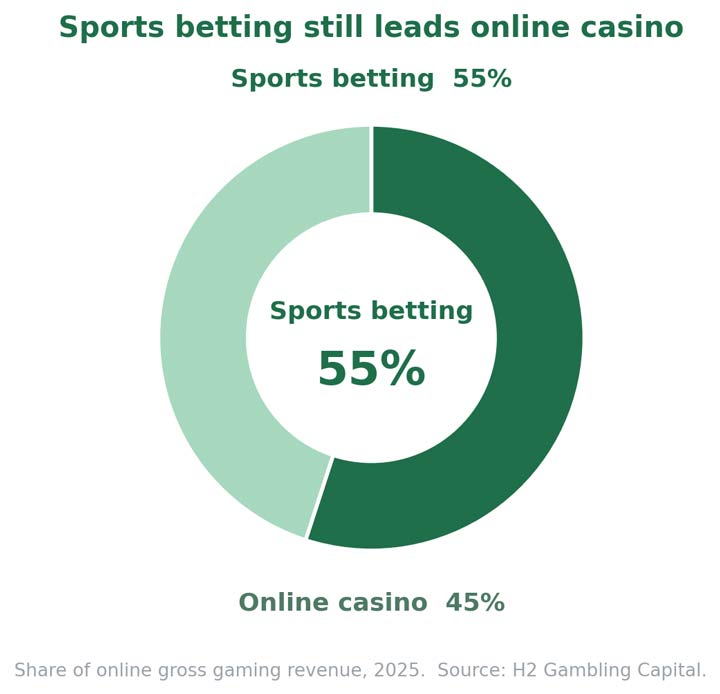
There is no longer any need to read search-volume tea leaves, because a full year of revenue tells the story directly. The split is close. Sports betting brings in about 55% of online GGR and online casino games about 45%, according to H2 Gambling Capital. Football rules the sports side, accounting for roughly 86% of sports-betting revenue and most of the bettors. Online casino is the faster grower of the two, carried by slots and “crash” games, and the segment is on track to rise from about US$1.1 billion in 2024 to roughly US$1.6 billion by 2028.
Sports and Competitions Mostly Bet On
The above-mentioned study conducted by BtoBet also reports that the football is by far the most popular sport to bet on in Brazil, which is no surprise, of course. Eight out of ten study participants reported their preference to bet on that sport.
Away from football, Brazilians also bet on basketball, MMA, volleyball, tennis, American football and, more and more, esports, where the country holds one of the largest fan bases in the Americas. MMA in particular has taken off, giving sportsbooks a strong second market after football.
The study also demonstrates that the National Championship, the local football leagues, followed by the Libertadores Cup and the Cup of Brazil, receive the most bets as compared to other leagues, competitions, or sports events. The money has flowed straight back into the game, too. Betting firms are now the biggest sponsors in Brazilian football, with Betano backing the top-flight Brasileirão and a betting brand on the shirt of almost every major club.
Preferred Online Casino Games
Now that online casino is fully regulated, it has become a real pillar of the market, worth well above US$1 billion a year and still rising. Under the rules every game result has to come from a certified random number generator, and live-dealer studios face physical security checks.
Some core aspects of a casino online valued by gamblers in Brazil include SSL security, positive reviews from reliable reviewing websites, established partnerships with credible payment brands and software providers, a license from a trusted regulatory authority.
As for the games themselves, slots lead the way, with the fast “crash” titles pulling in a large share of casino revenue, followed by live-dealer tables, roulette, blackjack and video poker.
Mobile Gaming in Brazil
Brazil’s gaming market is constantly growing. New data from data.ai confirms Brazil’s mobile app market is booming in LATAM, a region ‘ripe for growth on mobile’.
The connectivity behind all this is striking. At the start of 2025 Brazil counted about 183 million internet users, or 86.2% of the population, and roughly 217 million active mobile connections, more than one per person. Around 60% of Brazilians get online only through a phone, and on the betting side the tilt is even sharper: data from mid-2025 showed that nearly 99% of visits to licensed betting sites came from mobile devices.
Brazil is characterized by a very high level of the daily time spent on the Internet. With its 10 hours 8 minutes per day the country stands way far from any European country, such as Germany, for instance, with its daily 3 hours and 26 minutes.
Since the COVID-19 pandemic, Brazilians have been relying more and more on their mobile phones for their shopping, financial needs, gaming, and leisure.
The growth of internet-connected mobile devices available in the Brazilian market and thus owned by Brazilians and used for mobile gaming has given freedom to the players to place bets from whatever place or time even on the go.
High penetration and ownership of internet devices and mobile phones are driving the growth of the mobile device segment in the online gambling market of Brazil. Marketing through mobile advertising provides the most effective communication mode with a higher market penetration attracting a huge customer base of smartphone holders to online casino games, eSports betting, etc. Speeds have improved as well. The median mobile download speed reached about 81 Mbps by early 2025, up more than 70% in a year, which is fast enough for live in-play betting and live-dealer streams on the move.
New iGaming Trends in Brazil
Sports betting and online casino dominate the headlines, but they are only part of Brazil’s online gambling picture. Several neighbouring formats are expanding fast, carried by the same young, mobile audience. The three with the most momentum are esports, fantasy sports and social gaming.

eSports
Brazil is one of the world’s most committed esports nations and the clear leader in the Americas, with big audiences for titles such as Counter-Strike, Valorant and Free Fire. The 2024 Free Fire World Series final was even staged in Rio. That fan base feeds straight into esports betting, which the 2025 rules treat as a permitted market and which is growing quickly alongside football.
Fantasy Sports
Fantasy sports are skill-based games that have gained a lot of popularity in the country. Fantasy sports are online prediction games where you gather a virtual team of real sports players. You earn points based on real life statistics which are afterwards converted into ‘fantasy points’.
CartolaFC, the fantasy football game run by media group Globo, is still the format’s heavyweight, pulling in millions of players every Brasileirão season. The 2023 law treats fantasy sports as skill-based, so they do not need an SPA betting licence, a lighter touch that has helped the format keep growing.
Social Gaming
A social game is a structured activity which has contextual rules through which users engage with one another. Social games are multiplayer enabling people to interact with each other during gameplay via messaging and integrated social media.
With over 90% of Brazilians being mobile internet users, and, on average, spending over 5.4 hours on the internet each day on their mobile devices, Brazil is the third highest mobile-internet-usage country in the world, following Thailand and the Philippines. Given the online payment methods are becoming more and more accessible, all these factors create a very attractive environment for the growth of social games.
The Prospects of the Gaming Market in Brazil
With the market legal and growing, the question has changed from “when will it be regulated?” to “how well can it be run?” Several forces are shaping what happens next:
- the ongoing technological advances including artificial intelligence and machine learning tools help understand the consumer preferences
- concepts of Virtual Reality and Augmented Reality being introduced by numerous online gambling companies to provide an enhanced gaming experience
- improvement of the payment methods including the integration of blockchain technology in the online gambling business
- increasing investments in the online gambling market
- the federal framework itself, which has pulled billions of reais out of the grey market and onto the tax rolls.
No doubt, Brazil’s potential is enormous. The huge population with its massive participation in social networks, digital consumption and passion for gambling make Brazil a future paradise for investors, software providers, gambling operators. The legal foundation that was missing for so long is now in place, and the harder questions have moved to tax and harm.
Tax is the first pressure point. After the market’s strong start, Congress approved a gradual rise in the GGR levy through Complementary Law 224/2025, taking it from 12% to 13% in 2026 and on towards 15% by 2028. Once PIS/COFINS, municipal ISS and corporate taxes are added, the real burden already lands near 36% of GGR, and operators warn that pushing rates higher will only send players back to the unlicensed market.
What Operators And Players Pay
| Charge | Rate |
|---|---|
| GGR betting levy | 12% (2024–25), rising to 13% in 2026, 14% in 2027, 15% by 2028 |
| PIS / COFINS | 9.25% of GGR |
| Municipal ISS | 2% to 5%, depending on the city |
| Corporate taxes (IRPJ / CSLL) | Standard rates on profit |
| Effective burden | Around 36% of GGR |
| Player income tax | 15% on net winnings above R$2,824 |
Source: Law 14,790/2023 and Complementary Law 224/2025.
Harm is the second pressure point. The market’s fast take-up exposed a real social cost, with studies showing welfare money leaking into betting. In September 2025 the government barred people receiving the Bolsa Família and BPC benefits from fixed-odds betting and required operators to check every player’s CPF against a welfare database. Together with the self-exclusion register, advertising limits and deposit controls, responsible gambling has become as central to Brazil’s story as the revenue.
Land-based gambling is the third open question. Resort casinos, bingo halls and the jogo do bicho are still illegal, and the bill that would legalise them, PL 2,234/2022, remains stuck in the Senate. Supporters say regulated casino resorts would create hundreds of thousands of hospitality jobs and lift tourism, while opponents, wary of the social fallout from the online market, are in no rush to expand gambling further.
José Calisto, president of the Association of Hotel Employees and Similar of Rio de Janeiro (AEHSRJ), commented
“It is very important to legalize casinos in Brazil, even if, at first, it is only approved in resorts and, in a second phase, expand to the rest of the tourist spots and other spaces. Today there are casinos and bingos distributed all over Brazil in a clandestine manner. If they were legalized, there would be job and income generation”.
The official estimates that 300,000 direct jobs (and a similar number of indirect jobs) would be created in the hospitality sector if casinos or resorts were legalized.
The verdict our 1H2022 report was waiting on has arrived: regulation worked, the money is real, and the world’s operators are already here. What is left to settle is a tax level the market can live with, a smaller illegal sector, solid protection for vulnerable players and the unresolved question of land-based casinos. Those four issues will decide how Brazil’s gambling market looks for the rest of the decade.